A Low-Level UDP Echo Server for NAT Traversal
A common challenge with UDP-based systems is navigating NAT (Network Address Translation). While IPv6 is designed to solve this by giving every device a globally reachable address, for now, we still have to contend with NAT’s limitations.
Until a router establishes a NAT mapping, incoming packets cannot be forwarded to a device inside a private subnet. To make this work, packets must first originate from the inside.
I didn’t want to get bogged down in the complexities of full NAT traversal, especially for P2P-style communication. Up until now, I had a simple workaround: client devices sent “junk” UDP packets to the server every 8 seconds to keep the mapping alive.
Recently, however, some ISPs (especially Jio) started blocking these outbound “heartbeats.” Interestingly, we found that if the server actually responds to these packets, the connection remains stable.
But there’s a catch: handling these responses in a userspace process adds significant overhead. To solve this scalability problem, I started looking into tools provided by the Linux kernel.
The Evolution of the Solution
1. iptables
iptables is the legacy filtering and processing tool in the Linux kernel. I was already using it to drop certain NAT
packets before they even hit the connection tracking (conntrack) system. However, iptables is quite limited when it
comes to “reflecting” packets back; it just isn’t designed for that level of manipulation.
2. eBPF / XDP (eXpress Data Path)
XDP runs directly in the network driver (or even on the NIC hardware), processing packets before the kernel even
allocates an sk_buff (socket buffer).
By “reflecting” the packet at the lowest possible layer, we can avoid the entire overhead of the Linux networking stack, context switching to user-space, and memory copying. I experimented with a small C-based eBPF program that:
- Swaps the Source/Destination MAC addresses.
- Swaps the Source/Destination IPs.
- Returns
XDP_TXto transmit the packet back out the same interface.
The downside? It’s too low-level. You have to manually calculate checksums for Ethernet, IP, and UDP headers. I felt a bit unsafe working at that level for this specific task.
3. nftables
nftables is the modern alternative to iptables. It’s safer than XDP because the kernel handles low-level memory
safety, but it’s much faster than a user-space process because the packet stays entirely within the kernel.
I found nftables much easier to maintain. You can organize your logic into chains and rules within .nft script
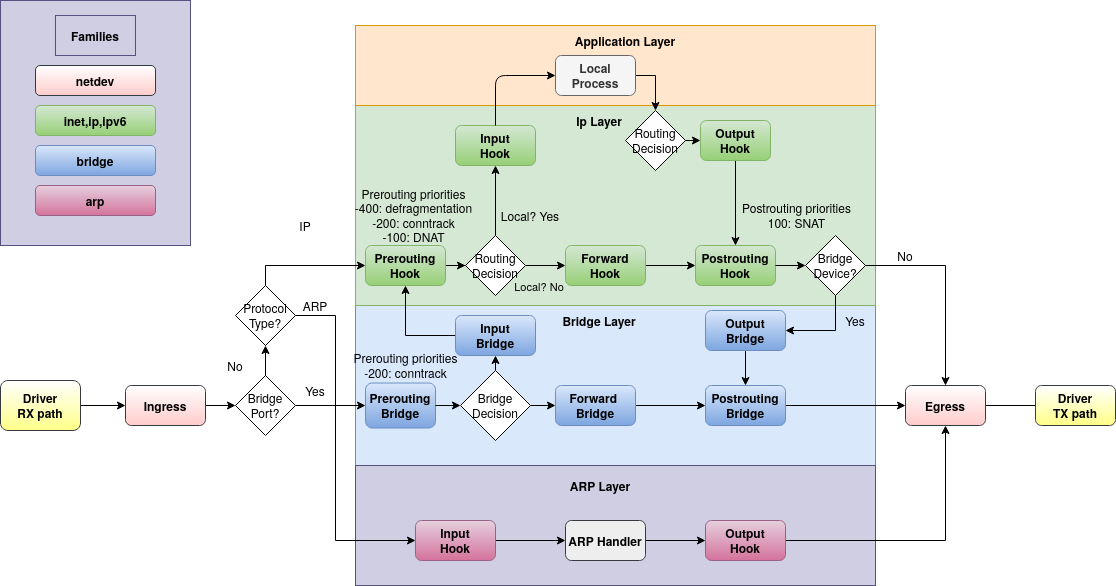
files. After some research, I determined that the prerouting hook at the IP level (before conntrack) was the ideal
place for the reflection logic.
The “Trial and Error” Reality
Documentation for these essential low-level tools is surprisingly sparse. I couldn’t find many clear resources, so it took a lot of trial and error with the scripts until things finally clicked.
One important note: since this is a stateless reflection, certain values (like the source IP to reflect from) currently need to be hardcoded. While I could maintain a dynamic map, it started to look like what conntrack is doing: maintaining the source-destination mappings. I was hoping to dynamically extract the source IP from the interface itself, but haven’t found a clean way to do that yet.
The Implementation
You can find the final nftables configuration in this Gist:
UDP Echo Server via nftables